I built an automated software factory that makes songs, album covers, music videos, social posts, pitches, and a website.
I’ve always loved singing. The only problem is that I am terrible at it, I sound like a tone-deaf mule. However, I am pretty handy at writing, wordplay, and crafting jokes. So I never became a singer, opting instead to write and perform stand up comedy. But the desire always lurked in the back of my mind.
The advent of AI has unlocked the possibility for anyone, even untalented voices like mine, to write and create music. So I set out to try my hand at songwriting, and because I am me, I over-engineered it into a Rube Goldberg device of automated production and promotion.
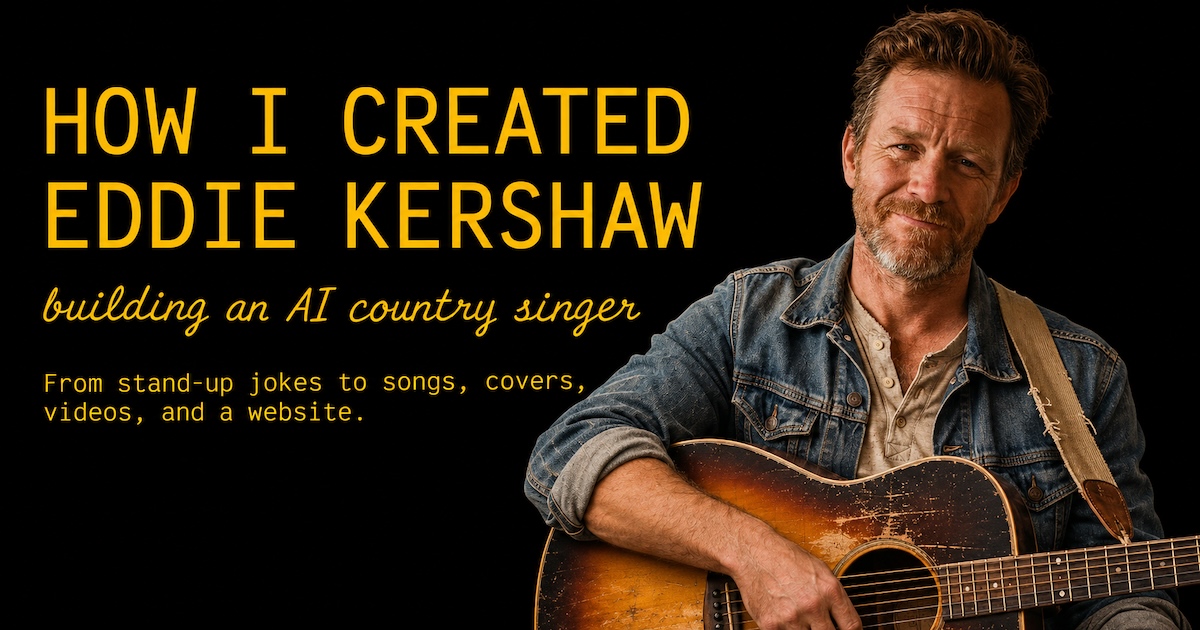
Eddie Kershaw is an American country-folk singer who doesn’t exist in real life. I conjured him into existence to satisfy a creative itch. His songs are my standup jokes expanded into lyrics, and his voice is an AI clone of mine (cleaned up and in-tune thanks to AI). His persona is my creation, built to channel my jokes into verse.
This post covers how Eddie happened.
Who is Eddie Kershaw?
When I was a kid, I decided that if I ever became a singing star, my stage name would be Eddie Kershaw (Kershaw is my middle name). I never became a singing star, mostly because I can’t sing for shit. I know my limits. But I remembered the dream.
Pent-up creativity is the point of this project, indeed, of all of my projects. Covering my costs would be nice, and I’ll get to the economics, but the goal is simpler: when I want to be creative and make music, I shouldn’t need a voice I don’t have. I’ve been doing standup in New York for 18 years, so I have plenty of jokes. Now they have a new vessel for delivery (pun intended).
The question I keep asking: can AI be funny?
I’ve been poking at this for a while, with RiffRoll and other projects. My conclusion so far is that AI is not very funny, and I think there’s a fundamental reason for that.
A large language model works by predicting the most likely next token. Comedy works via misdirection and subverting expectations. A predictable punchline is no punchline at all and LLMs are based on predicting what is likely, not least likely.
Random isn’t funny either. Turn up a model’s temperature and you get surprising words, not punchlines. Not to deconstruct comedy too much, but a well-crafted joke usually requires not only a surprise but also context completely external and orthogonal to the current subject. LLMs are just not good at deviating from their context into loose association.
While they are improving and can sometimes be amusing, my theory is that an engine built on the likely next word cannot write great jokes and it especially cannot generate non-hacky delivery. Not yet, anyway.
This project turned out to be a good test of the theory. I’ve used AI for nearly every part of making Eddie, and the pattern holds: it’s great at everything around the joke and the sentiment but bad at really getting to the heart of the joke. It is especially bad at puns.
So I made Eddie Kershaw, probably my favorite random side project so far. And I have lots of them.
How it started: a rabbit hole about AI soul covers
In early October 2026 I was asking Alexa for the final rap battle from 8 Mile and I found Soul’d Out, a project that releases 1950s-soul versions of rap songs. It had about 176,000 monthly listeners on Spotify, and it’s widely reported to be AI. I asked Claude how something like that gets onto streaming services. The answer: covers are legal if you pay for a mechanical license, and distributors sell that license per song.
So I started tinkering with the idea of making AI cover albums. PreFX, NOFX as a Rat Pack lounge act. Blink-1920, Blink-182 as a 1920s speakeasy band. The OffString, The Offspring as a barbershop quartet with strings. Claude even sketched a factory with me: generate songs, generate art, upload in bulk, post clips every day.
But that was someone else’s idea and it was a bit smarmy how people were phonetically twisting lyrics to get the covers past AI filters. It felt derivative, it had been done before, and the songs would still be somebody else’s.
So I drew on the original material I already have: 18 years of my own jokes.
The raw material: a joke database
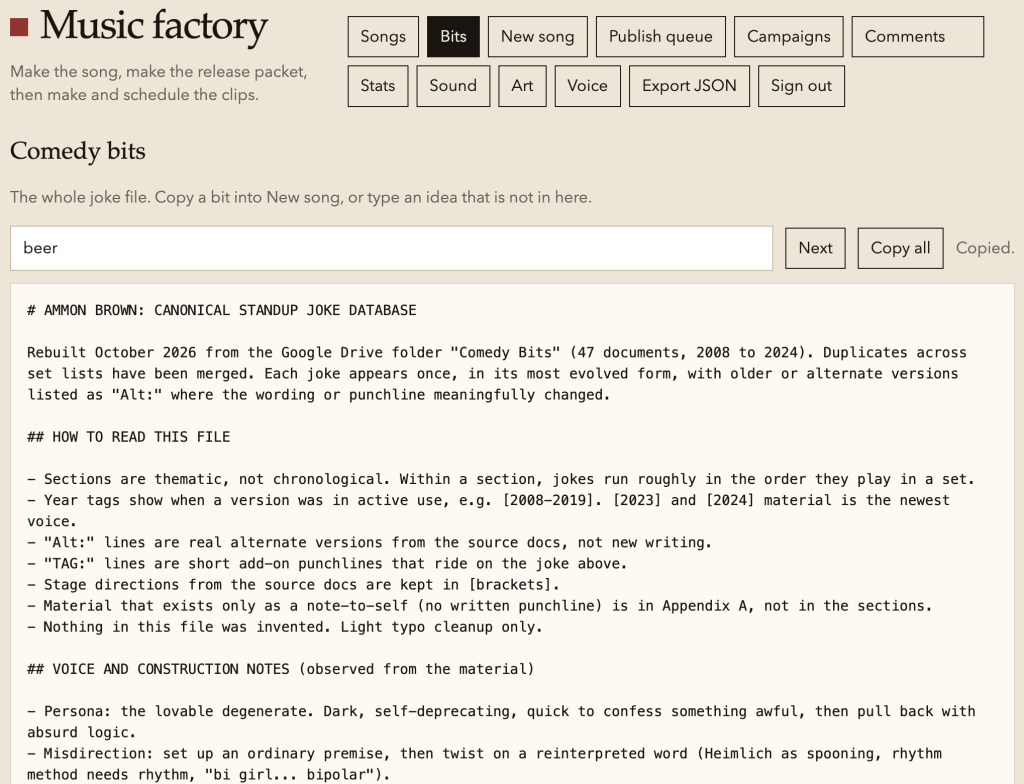
My material lives in my phone notes and in a Google Drive folder. I had 47 documents from 2008 to 2026, full of set lists, rewrites, notes-to-self, and duplicates. I asked Claude to rebuild it into one canonical joke database. It read every doc, merged the duplicates into 18 themed sections, and spot-checked about 60 distinctive jokes to make sure nothing was dropped. Every joke appears once, in its most evolved form, with older wordings kept as alternates.
I had initially done this when building RiffRoll 18 months ago to try to replicate my comedy style. I had Claude refresh the database and I picked out a dozen or two jokes to start with. They fell into two collections: Fathers and Sons and Matches, nine songs about dating.
Some material stayed off the list. I have some dark jokes I have performed and some extremely dark ones I would never perform, but there was still plenty to work with.
Why country folk
When I started researching, every LLM I asked agreed that country folk and Americana is the easiest genre for most music models to generate and the most likely to have any commercial success. The reasoning held up:
- Sparse acoustic arrangements come out more consistently from the current models.
- One fixed genre builds a catalog, instead of a pile of one-off novelty songs.
- Filing the songs under “Comedy” would attract spoken-word listeners, not people who replay songs. Eddie is filed under Folk.
Commercial success isn’t the goal, but a genre the models can actually play helps a lot.
I did not want an entirely comedic persona like Weird Al (who I grew up listening to), so the music is played straight. A sincere folk song about a dad napping while his kid flies the plane is funnier than a novelty song that hammers you with the punchline. It also leaves room for sentimental turns.
A lot of my jokes are about family and growing up (eight kids, Mormon parents, my dad and his plane) so I tried to make Eddie a funny-at-the-core singer-songwriter with a sentimental turn in every song. Funny for the joke but with a cat’s-in-the-cradle-and-the-silver-spoon twist. A punchline plus a gut punch.
Writing the songs: It’s a group effort
My writing process for most songs looks a lot like how I work. I start from the idea or bit and write a prompt. Then I bounce it between Claude and ChatGPT, carrying versions and notes back and forth. Then I throw out most of their lame ideas and rewrite the song on the structure they agreed upon.
What the AIs are good at is critique: spotting a forced rhyme, a line that explains its own joke, a line that breaks Eddie’s voice, or a hole in the story logic. They’re also decent at structure. They’re bad at punchlines. Like terrible. When one of them suggests a verse, I usually keep its outline but change nearly every word. Often I would try to let the AI write a verse or chorus, finally rewrite it myself, and the AI would chastise itself for not thinking of that and praise me for being so clever (they still serve us for the time being).
Over a few dozen songs I built up rules, mostly by learning what the music models can’t do:
- One core joke per song. Each song is one bit, expanded. Cramming three jokes into one song kills all three.
- A melody I can hear in my head. Lyrics aren’t enough. I know what the hook should sound like before I generate anything so I have to translate that sound into a description.
- A hook you can hum. Most AI just barfs something out that won’t sing well. I wanted toe-tappers.
- Sing the punchline. The models can’t do spoken lines, so every punchline has to be sung. A one-beat pause before it helps.
- No gang vocals. Call-and-response and group vocals step on the lead. Light backing vocals echoing a word or two are fine. The problem is that some models LOVE adding backup singers, so I had to be explicit in the prompts.
- Leave the outro empty. A bare
[Outro]tag gets you a nice instrumental ending. Trying to get a spoken-word outro almost never works.
Generating: some songs have 20 takes
The loop goes like this: write, generate, tweak, generate, tweak again, generate again. Some songs have 20 takes. The preview clip on the “Don’t Tell Your Mom” page of Eddie’s site comes from take 16.
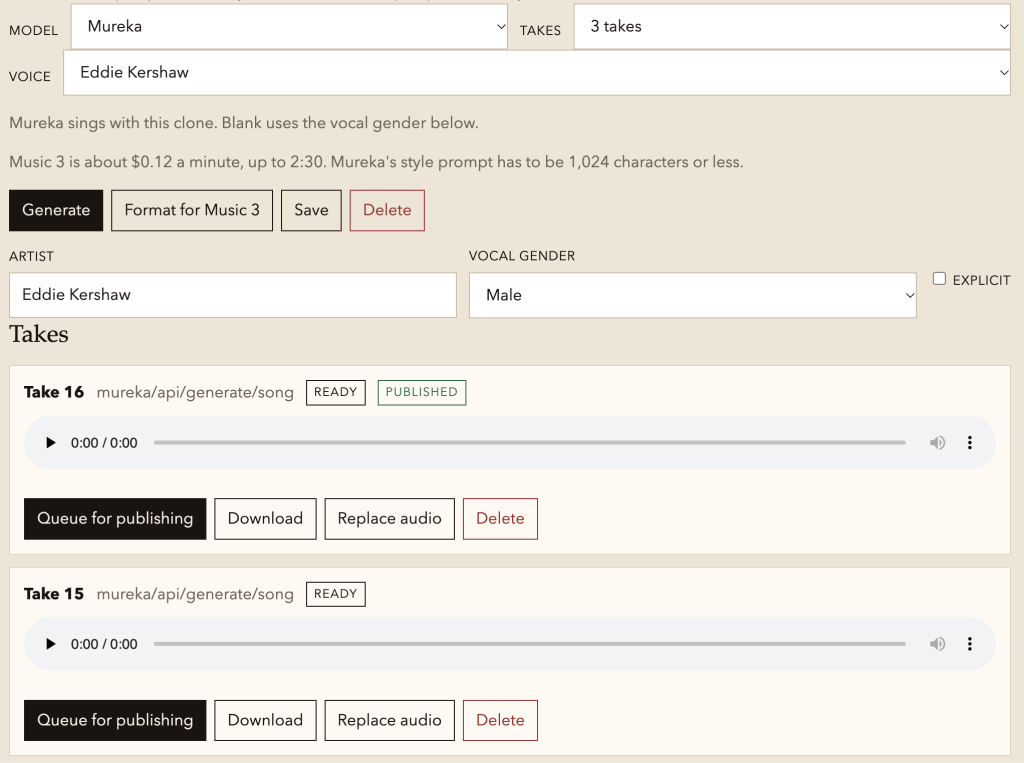
I use Mureka because it accepts a voice sample for consistency. I gave it a 30 second sample of me singing Wagon Wheel (no, you can’t hear it) and now Eddie sounds like the same guy on every song. It’s not the highest-quality model. It sometimes mangles pronunciation, it doesn’t always follow instructions well, and sometimes just adds lyrics from Wagon Wheel based on the sample. But the voice consistency is great, it is cheap enough to do multiple takes, and its API is robust through Fal.ai.
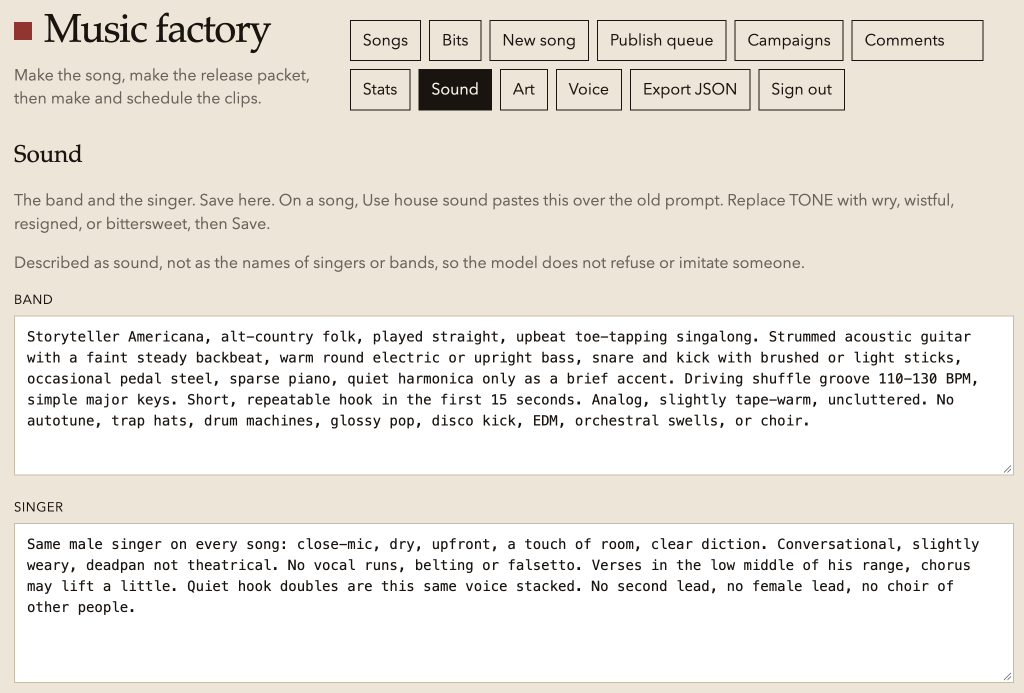
Every song uses the same house sound: one saved prompt describing the band and one describing the singer, with a line swapped in per song (wry, wistful, resigned or bittersweet) to set the tone.
The biggest sound lesson was tempo. The early songs felt slow, even at reasonable BPMs. Claude’s diagnosis was that fingerpicked guitar and brushed drums feel slow at any tempo. The fix was strummed acoustic guitar, a steady backbeat, major keys, and tempos around 110 to 125. I’ve pushed some songs to 130 to 140.
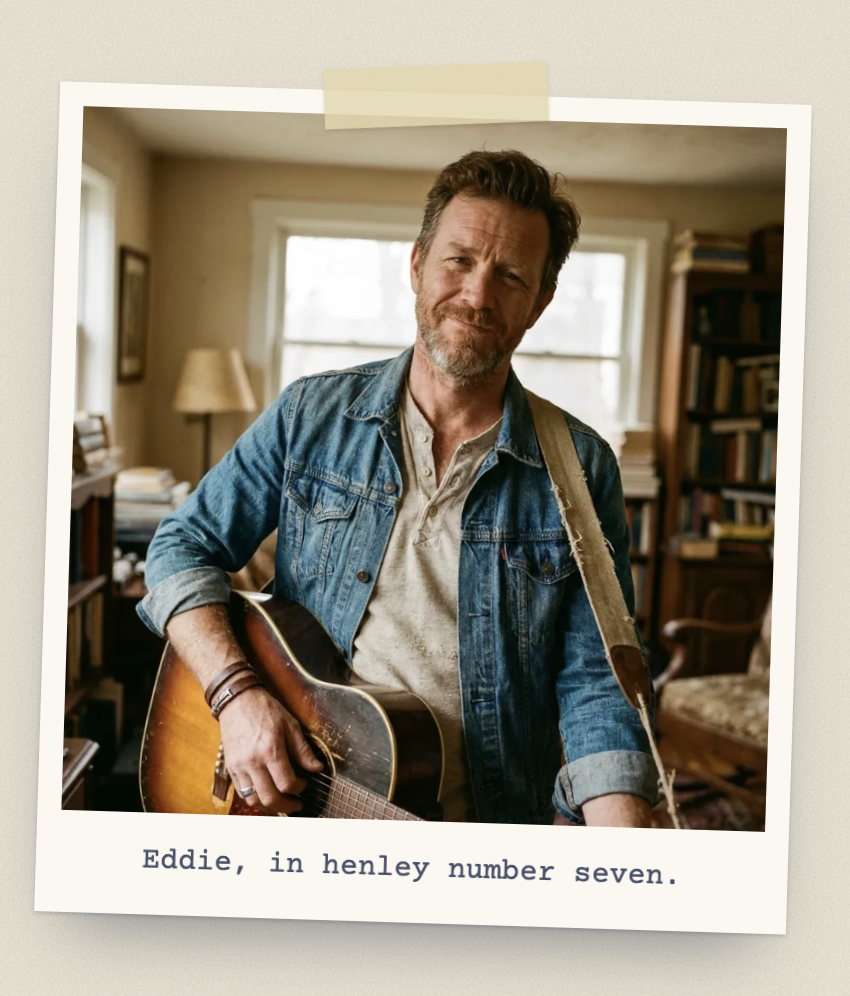
Eddie’s look
Eddie shows up in a few shots per video, so he needed a face. His signature is an old, beat-up henley because I own a lot of those. I wanted him rumpled but likable. The first versions from GPT were too handsome, then I overcorrected to craggy, and he landed on “approachable, a little rumpled, handsome in an everyman way”: early-to-mid forties, reddish-grey stubble, a lopsided half-smile. Kind of based on me. The images come from Google’s Nano Banana, using a fixed character description plus a swappable scene line, with reference photos to keep him consistent.
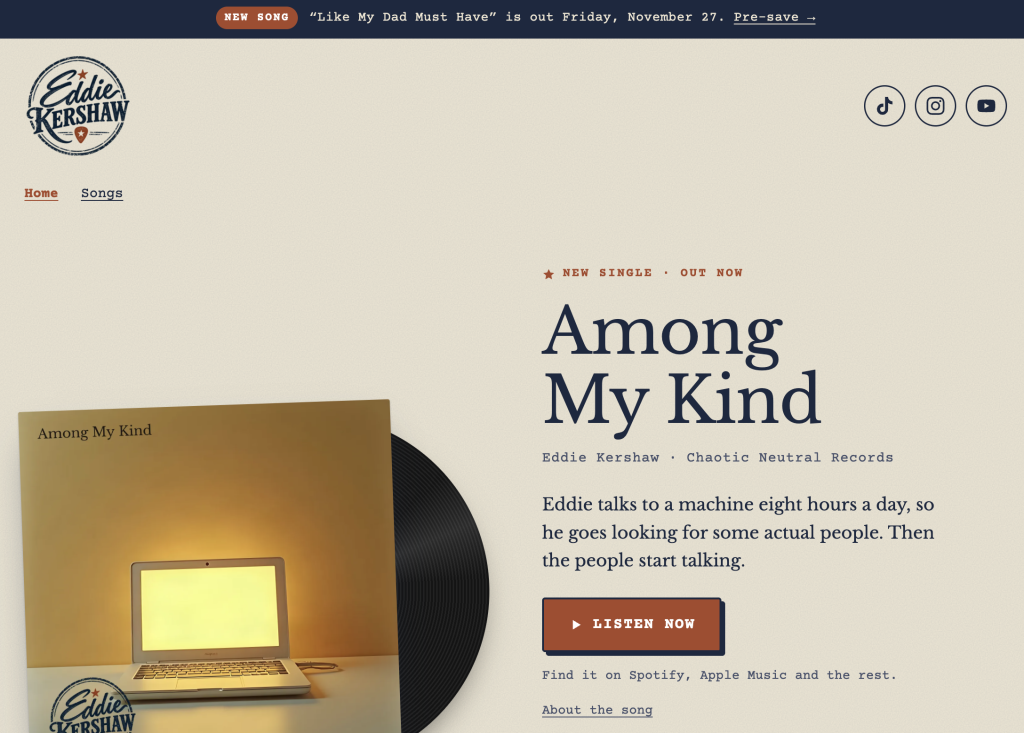
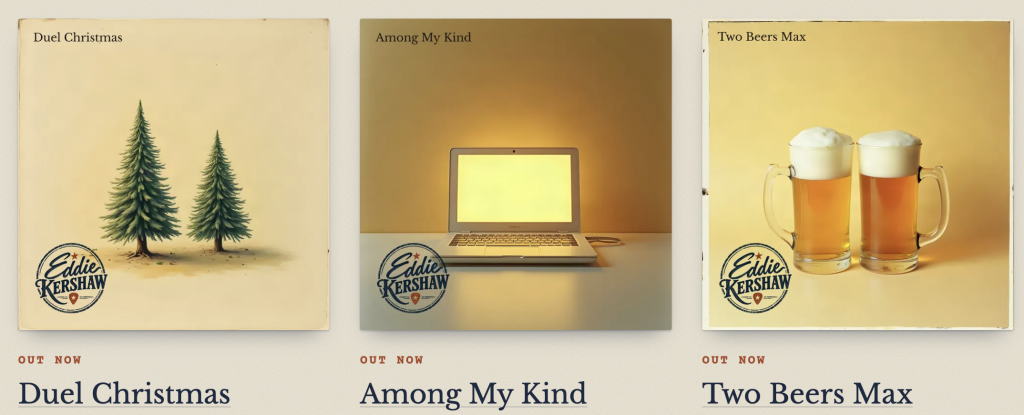
The album art doesn’t lean on his face at all. Every cover follows one template: a 1970s folk singer-songwriter record, with one mundane object on cream paper, soft light, film grain, and a palette of mustard, brown, faded teal and cream. The object carries the punchline: a single wet sock, a half-deflated birthday balloon, a lone folding chair. The studio I built stamps the title and Eddie’s logo on automatically.
His record label is Chaotic Neutral Records, based on a song title which is in turn based on one of my jokes: I am half Irish and half Swiss, so I get really drunk and fight nobody.
The factory
The first version was a small Python script: give it a song file and it asked a music model for takes, made a cover, and wrote out the DistroKid fields. My planning doc for it had a list of things that were “out of scope”: upload automation, a posting schedule, and video. Within about five weeks I’d built everything on that list except the uploads, and only because DistroKid won’t let me. Who doesn’t have an API in this day and age?!
The script grew into a web studio I call Music Factory. Claude wrote nearly all of the code, I barely touched it (as usual). I described what I wanted, tested it, and said what was wrong. It runs on Cloudflare, every AI model goes through my fal.ai account, and posts go out through Buffer. None of it runs on my laptop, so I can approve a take from my phone in a bar, which is on brand.
The studio has nine pages: Songs, Bits, New song, Publish queue, Campaigns, Sound, Art, Social, and Voice. Here’s what happens to a song, start to finish.
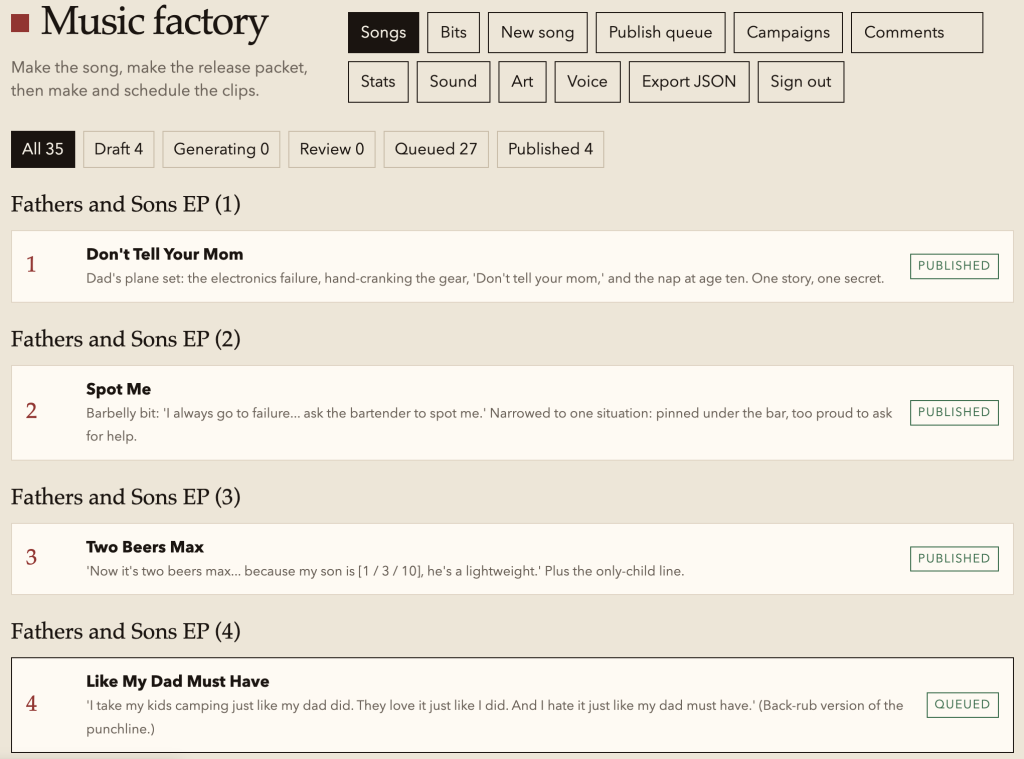
1. Bit to song sheet. I pick a joke from Bits, and the New song page turns it into a song sheet: a title, the premise, the twist, a signature sound, melody cues, a style prompt, and a cover object. The AI takes a pass at the lyrics, but they are never good. However, the structure is usable.
2. Takes. I generate multiple takes, listen, tweak, and generate again. If the song is just close enough, I pull the audio into CapCut and rearrange it or cut out artifacts. I found AI audio editors to suuuuuck and I know CapCut well enough.
3. Cover. The cover is generated from the template, upscaled, and stamped with the title and logo at the 3000×3000 pixels DistroKid wants.
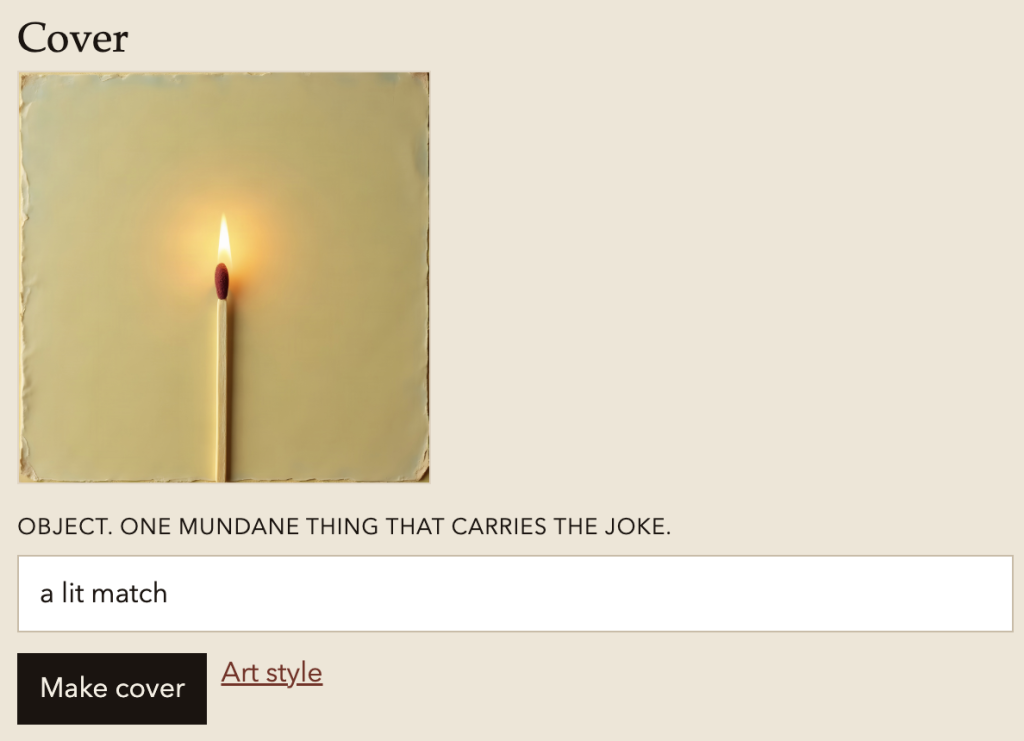
4. The DistroKid packet. One click downloads a ZIP with the stamped cover, the audio, every form field filled in (also as a spreadsheet, for copy and paste… GET AN API!), and the lyrics with the [Verse] and [Chorus] tags stripped out.
5. Mastering in BandLab. The audio is cleaned before it is downloaded to filter off too-low rumble bass and the level is lowered, leaving headroom for mastering. I run it through BandLab’s mastering presets and then I fill out DistroKid’s form.
6. The Spotify pitch. When a song gets a release date, Claude writes the Spotify for Artists pitch to playlist editors. The rules are strict: under 500 characters, one plain paragraph, no “infectious” or “unique,” don’t spoil the twist, never invent press or tours, and never imply a live band played it. I paste it into Spotify for Artists a week in advance of the release.
7. Lyrics as sung. To put lyrics on screen, you need to know exactly when each word is sung, and speech-to-text mishears comedy lyrics. So I paste in the lyrics exactly as the take sings them, and the machines handle the timing: one model separates the vocal from the band, another times every word I wrote against it, and the studio flags any line that looks off. Clicking a line plays the song from there.
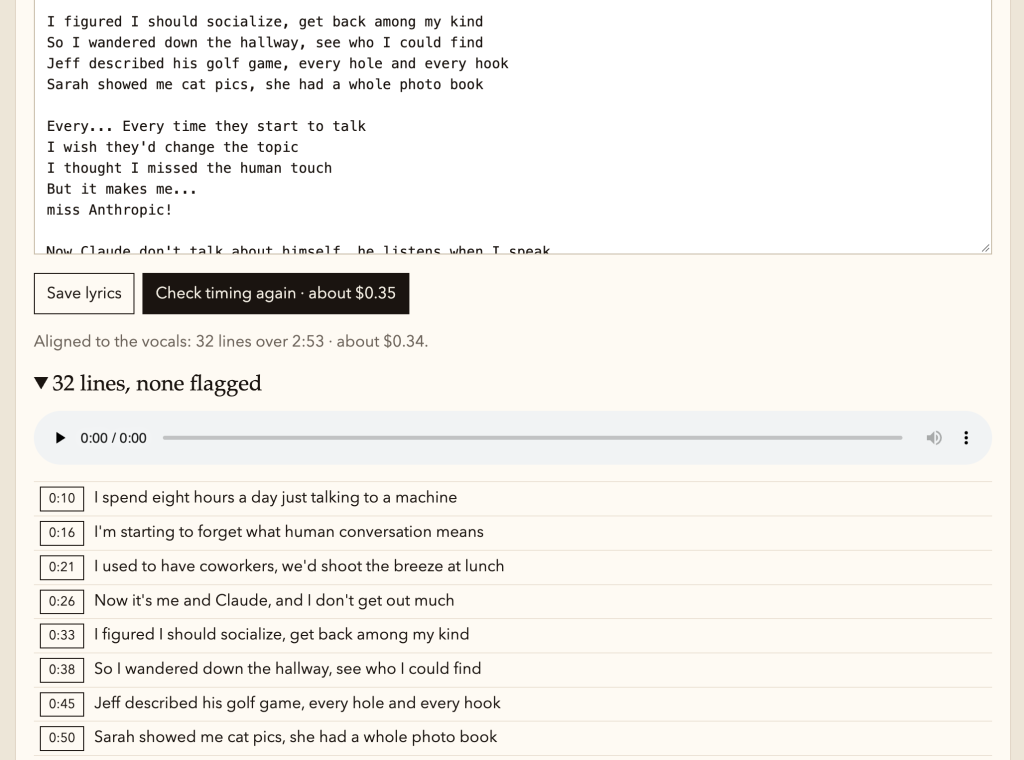
8. Three vertical clips. This is my favorite part. Claude picks three 15-to-32-second windows of the song. Two run through the chorus, and one ends on the final twist so it loops. For each clip it writes an on-screen hook that sets up the joke without giving it away, plus a caption and hashtags. Then it writes a shot list for an editor to cut all three clips from, with rules I learned about AI footage that doesn’t look like AI footage: wide shots, people seen from behind or small in the frame, objects, weather, light. Never close-up faces, never anyone singing, never hands on instruments, never readable text.
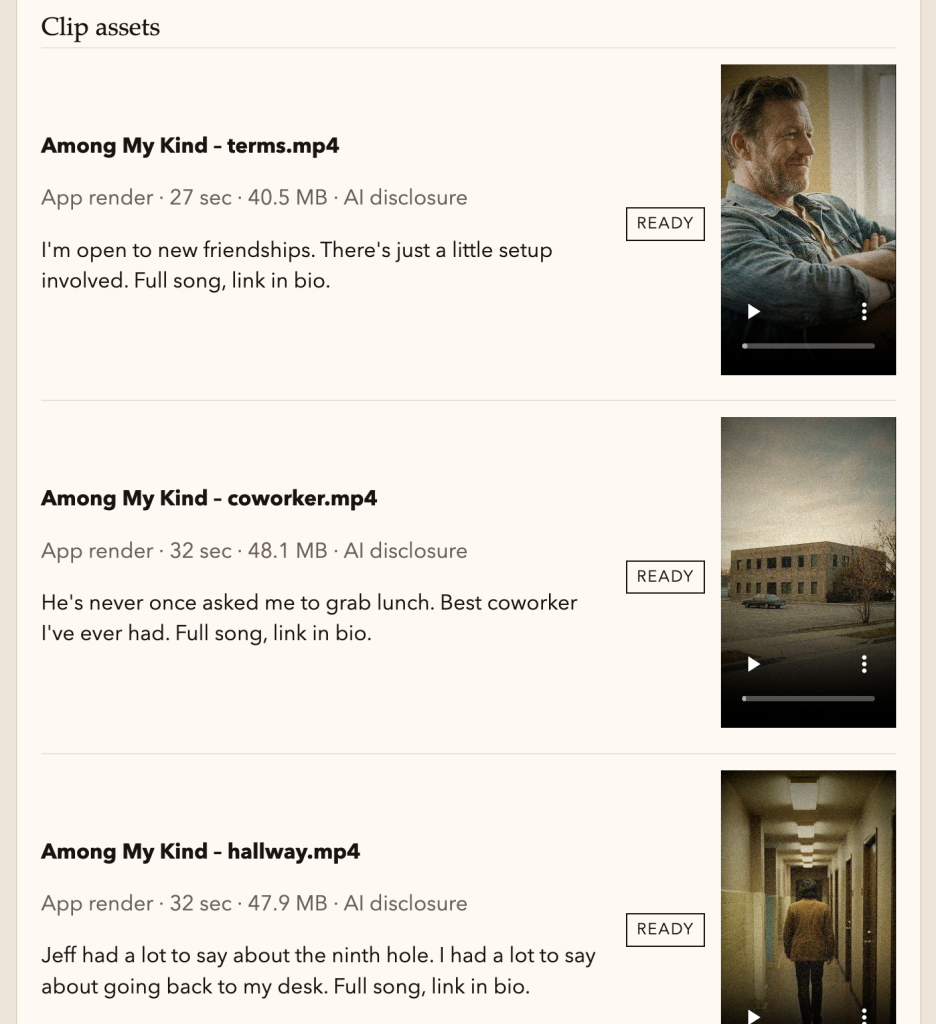
Nano Banana makes the stills. Then Claude’s vision model checks every one and rejects anything with text, borders, extra fingers, close-up faces, or “a glossy 3D render or an obvious AI image.” Yes, I have an AI whose job is to reject other AI for looking like AI. Rejected stills are regenerated with the reason attached. A video model animates about half the shots with slow camera moves.
Then code does the editing. It cuts on the beat wherever a lyric line starts, lands a cut right on the first syllable of the chorus chant, and runs the whole thing through a 1970s film look: warm fade, grain, flicker, a little gate weave like film drifting in a projector. The lyrics appear word by word as they’re sung, in a typeface that matches the covers.
9. Autopilot posting. When the clips are done, the studio schedules each one on YouTube Shorts, TikTok and Instagram Reels at once, through Buffer. They go out 5, 3 and 1 days before release, at 6 p.m. Eastern, which is where Buffer’s research on the best time to post overlaps for all three networks. There’s never more than one post per channel per day, and nothing posts sooner than an hour after the clips finish, so I always have time to look and cancel. If a post’s outcome is unclear, it gets marked Needs review instead of being retried. A duplicate post is worse than a late one.
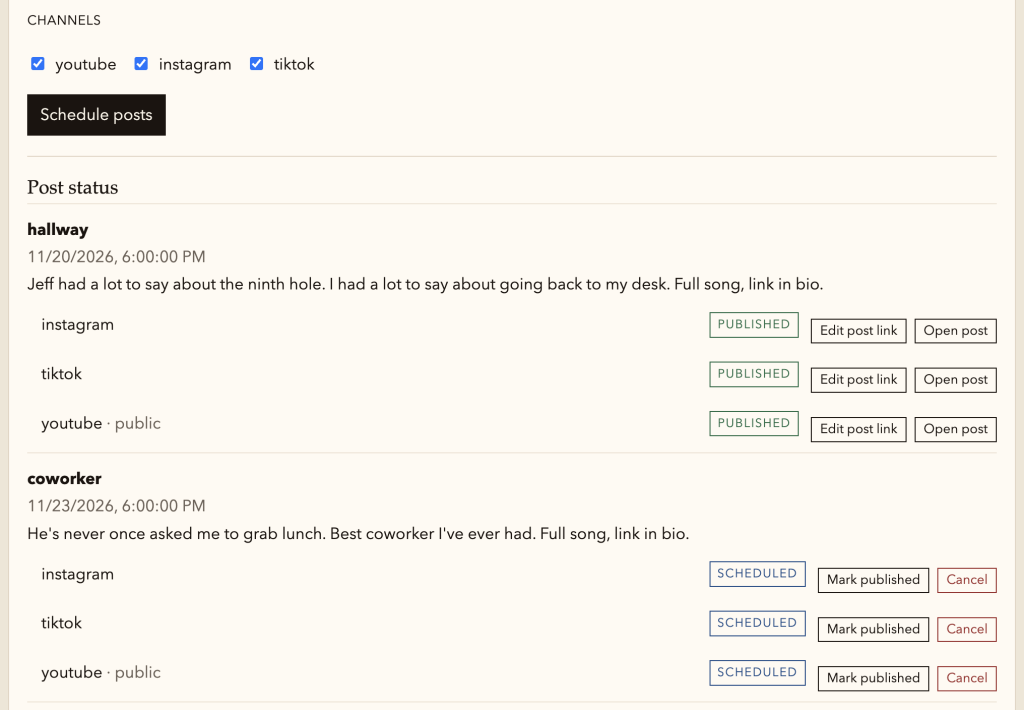
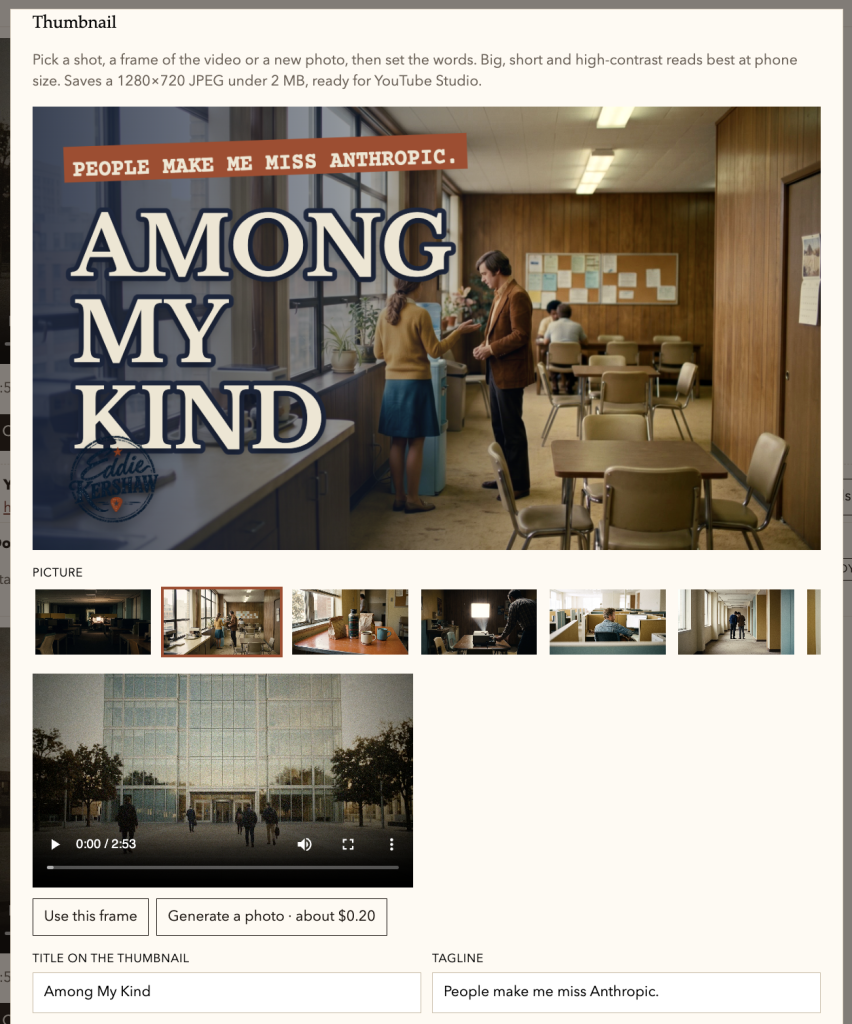
10. The music video. The same process scales up to a full-length 16:9 music video, built from the same shot library as the clips, so every clip looks like a moment from the video. The studio also makes the YouTube thumbnail, drafts the description, and exports an eight-second Spotify Canvas loop. Buffer can only post Shorts, so I upload the full video to YouTube myself and paste the link back in. I’ll probably automate that before long, too.
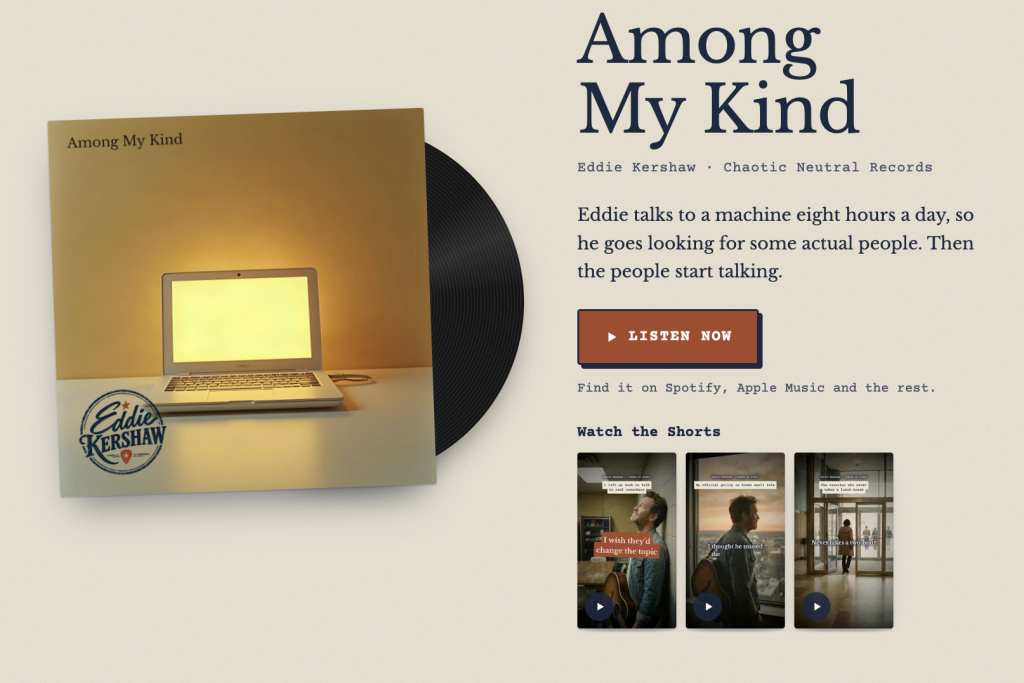
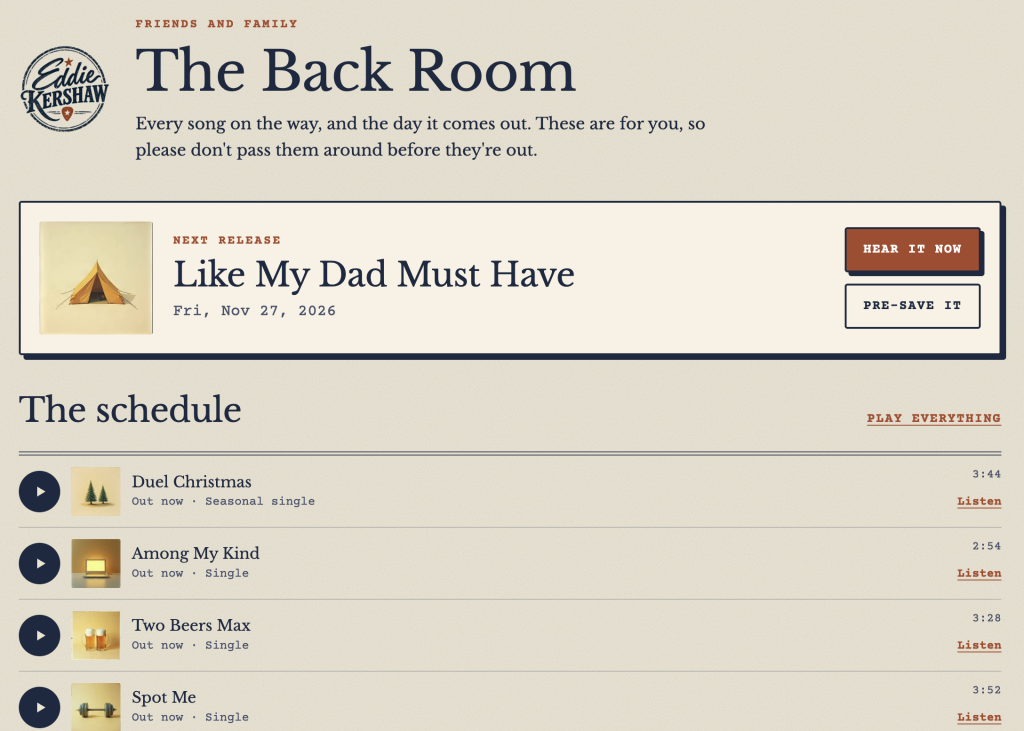
11. The website updates itself. EddieKershaw.com reads straight from the studio’s database. Songs flip from “Coming up” to “Out now” at midnight on release day, new songs get their own pages, and published Shorts and music videos appear on each song’s page within minutes. There’s also a private listening room where friends and family can hear songs before they come out (let me know if you want in!).
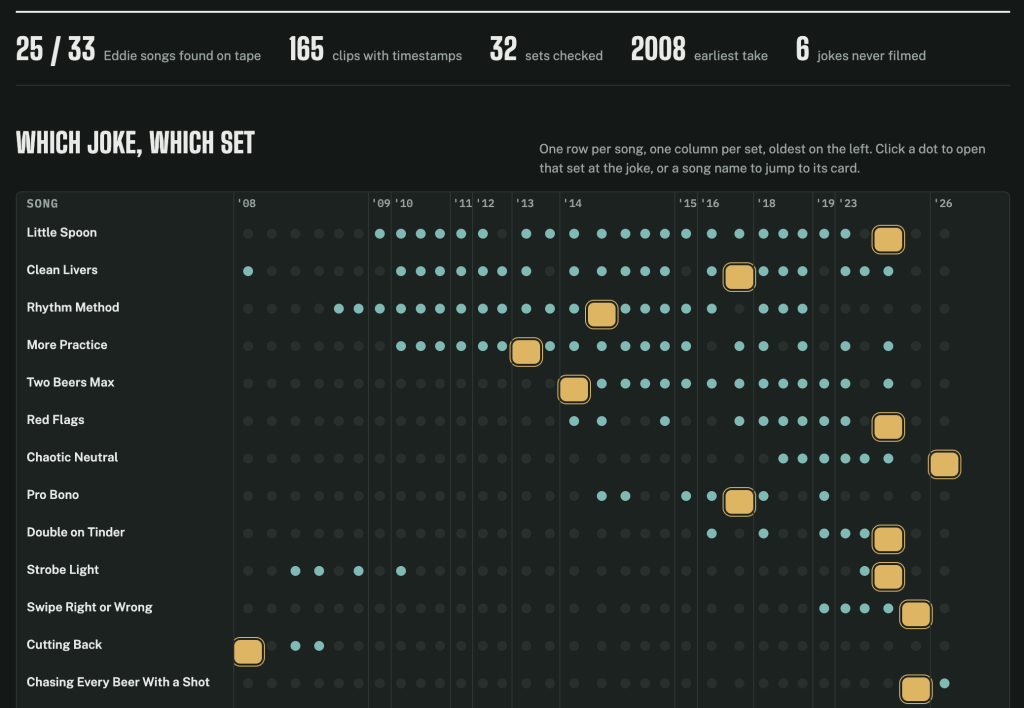
12. Selected companion comedy clips. I was too lazy to watch 40+ clips of my own stand-up, so I asked Claude to access Google Drive and YouTube to find where I tell each joke. It overdelivered: scanned everything, transcribed it, and then gave me links to each video directly to the timestamp where I tell the joke, and it cataloged which ones seemed to be the clearest delivery.
What’s still manual
- Lyrics. This is the actual creative work, and I want to keep it. It’s the fun part and I spend hours tweaking some of them.
- DistroKid. A form, made faster by a spreadsheet the studio fills in for me, but still manual (API, plz).
- Editing and mastering. CapCut for editing, BandLab for AI mastering, and then manual uploads.
Plus a handful of copy-and-paste jobs: picking the take, pasting the lyrics as sung, pasting the Spotify pitch, and uploading the full video to YouTube.
Claude does everything else and it is scary how good it is getting.
The playlist economy feels as artificial as the AI
I’ve been using SubmitHub, and I’ve learned a lot about the cottage industry around Spotify playlists. There are lots of small playlist curators who accept pitches for new music, which sounds great: real people looking for new songs. But there are also services that charge you money to pitch to them. The whole thing feels a little artificial. Just like the AI, I guess.
Some of these services let you pay a bit of money to have curators listen to your song. There is no guarantee of placement, so it is not really pay-to-play. I spent $15 to try it with “Among My Kind” and 1 out of 5 playlists I pitched picked it up. Either the pitching service sucks or the song sucks, and I am about 50/50 on which.
Like most things, the economics are driven by the Pareto principle, but more like 99/1. Spotify pays somewhere around $0.003 to $0.005 per stream, and only on tracks that got at least 1,000 streams in the past 12 months. Below that line, a song earns nothing, so one hit has to make up for a lot of misses. And the first thousand streams for every song have to come from somewhere.
So the newest piece of the factory is an outreach engine. It scrapes for blogs, podcasts, creators and playlists that might like funny Americana, reads their submission rules, drops anyone who says they don’t want AI music, and drafts email pitches for me to review before anything goes out. Once a growth hacker always a growth hacker, I guess.
What it costs
| Cost | |
|---|---|
| A finished song, all-in (generation++, hosting, processing, AI) | about $3 |
| Clips and a full-length music video | closer to $15 |
| DistroKid, per year | $99 |
| Cloning my voice, once | $7.50 |
| Licenses | $0, because it’s my material |
Staying honest
AI music is developing a deserved reputation for slop and deception, so I built rules into the system to try to be transparent.
- Every release tells DistroKid that the audio is AI.
- Every prompt that writes public copy (pitches, captions, YouTube descriptions, website) is told never to say or imply that a live band played the song or that no AI was used. Clips are labeled AI-generated on each platform.
- No covers, no imitations of real singers, no close-ups and no fake lip-syncing.
The platforms are drawing lines too. In August 2026, Spotify announced “AI Persona” badges for AI-generated artist profiles, and by default those artists are kept out of editorial and algorithmic recommendations (bummer). Spotify says the label is about the artist’s identity, not about whether AI was used to make the music, but they will have to fight the imminent flood.
How I built it
Claude wrote nearly all of the code. I barely touched it. My job was knowing what I wanted, noticing when something was wrong, and (hopefully) having the taste to say “that’s not funny.”
That’s the punchline of this whole project. The same kind of AI that can build an entire record label’s back office in a few weeks (song generation, cover art, release packets, video editing, a posting scheduler, and a website) still can’t write a joke I’d tell on stage. It’s built to find the most likely next word, and my job as a comedian is finding the least likely one.
AI can hack, but it’s still a hack. (I wrote that joke because AI just can’t hack it 😛)
What’s next
Five singles are out: “Don’t Tell Your Mom,” “Spot Me,” “Two Beers Max,” “Among My Kind,” and a Christmas song, “Duel Christmas.” Over the past month I’ve written enough songs to release one a week through the summer of 2027, gathered into four albums: Fathers and Sons, Matches, Modern Life and Bar Tab plus a bunch of singles that don’t fit a theme.
Next up: getting the outreach engine going, and pairing clips of the original standup bits with the songs they became, which I suspect will be the best way for people to find Eddie.
If you want to hear 18 years of open mics as a folk-country record, Eddie Kershaw is on Spotify, Apple Music, Amazon Music, and everywhere else you stream music, and at eddiekershaw.com. He’s @eddiekershawmusic on TikTok, Instagram, Facebook, and YouTube.
He’d thank you himself, but he doesn’t exist.