
DISCLAIMER: Of course I used AI to write this, but I did edit it like a good reviewer does. I also recognize that this lives in a grey area and so I will not be providing direct links to the properties I am talking about. Just trust me, bro.
Over the past year I have built AI-powered SEO and AEO automation systems three times, twice as internal tools and once as a hackathon experiment on weekends. I decided I would test my SEO-pumper-outer on my own properties and have started building a slop factory.
The system is called Content Empire, because subtlety is for people who lack ambition.
As of August 2026, the portfolio consisted of 59 domains and 6,306 published articles pumped out into the world. The system can find a niche, register a domain, create a brand, generate and deploy a fast and optimized static site, configure analytics, connect a content campaign, auto-publish new articles, watch search performance, and automatically optimize itself.
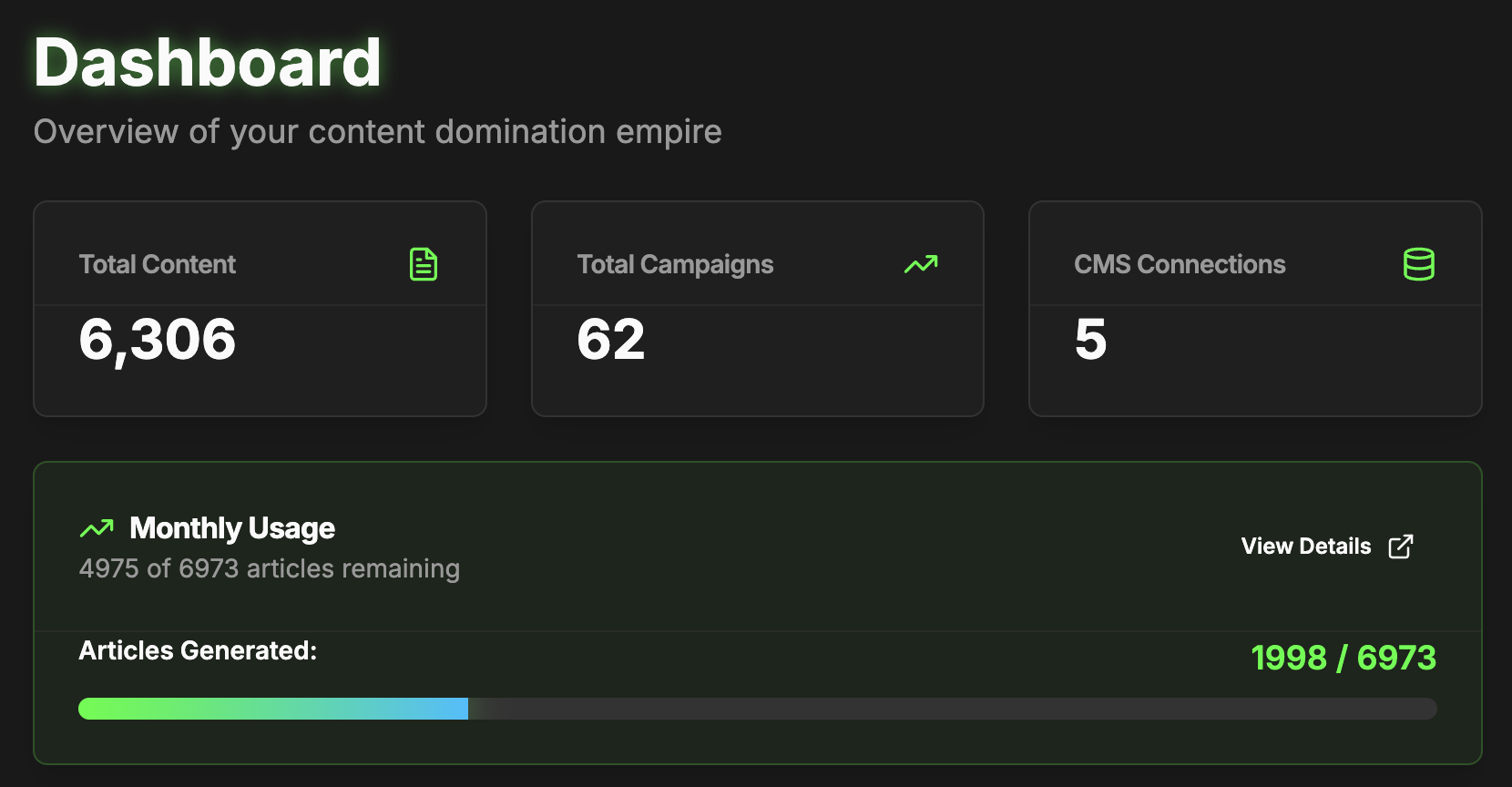
It runs mostly by itself, all I do is select a domain and click two buttons from time to time.
And yes, it has generated some revenue.
The short version: I wanted to find out whether a one-person operator could build a fully autonomous publishing portfolio using AI, automation, and affiliate economics. So I built on top of my existing AEO/SEO system and dogfooded it to create a network of niche slop sites.
First, let’s get this out of the way…
AI content is slop. I literally called the system I built SlopAds (with a more palatable sister brand Blogment). Yes, I built it in a few weekends for a hackathon, but that is a whole different story.

But I contend that human content is also frequently slop. I have attended meetings. I have read corporate blogs. I have seen a recipe writer spend 1,400 words describing their childhood pet before revealing the oven temperature.
The difference is that AI can produce slop at industrial speed and can tune it to be arguably more useful than some human slop.
Google is not a huge fan of this type of automation, but as long as it is useful to humans they do not necessarily penalize you.
However, they do have some policies around scaled content, and this may be in a dubious territory. So yeah, I will likely get penalized by Google and some of my sites already seem to have been, so this might be a very short experiment. 🤷♂️
But win or lose, it is still an interesting experiment on what it takes to outrun Google’s whack-a-mole system and produce lasting results in the AEO game.
The experiment
The first version of the experiment was pretty primitive:
- Ask Claude to find niches with commercial intent.
- Use Dynadot and Cloudflare to buy domains and launch focused sites.
- Connect them to SlopAds and publish a lot of content.
- Connect to my affiliate database and APIs to festoon articles with links
- Wait for capitalism to kick in.
This worked just well enough to show some promise before my laziness kicked in: could the entire loop run without me babysitting dozens of Search Console and Analytics properties?
So I did what I do best: Automate the shit out of it and disintermediate myself.
This is not intended to show you how to actually make money. If I wanted to do that, I would tweet a screenshot of a hockey-stick chart and claim that I have solved media like most bullshitters.
What Content Empire actually does
Content Empire started as a way to automate site deployment. It became an operating system for a small, strange publishing company with almost no employees.
The current pipeline looks like this:
niche → domain → brand/site → content campaign → revision gate → static build → Cloudflare → indexing → measurement → next action
1. It finds and records a niche
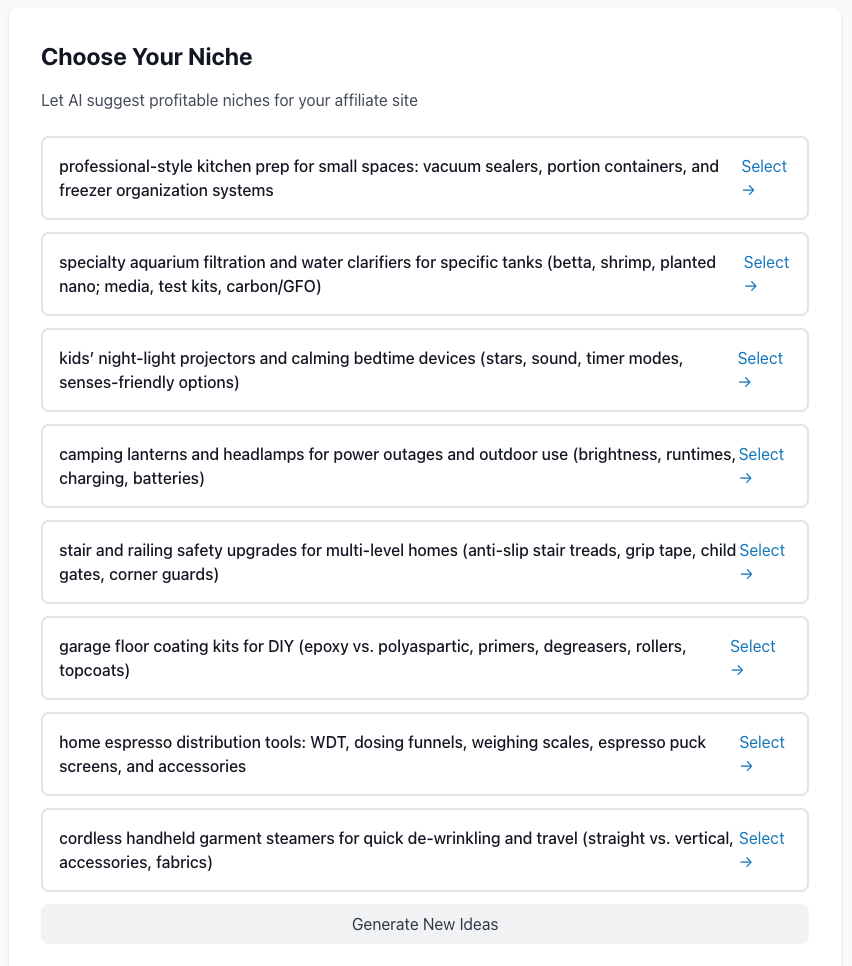
The system maintains a portfolio-aware prospect list so it does not enthusiastically recommend that I build the same site twice. A chosen or dismissed niche is recorded for deduping on the LLM niche generation call. It has specific instructions around prioritization and a scoring system to find less-competitive lucrative niches:
2. It creates the property
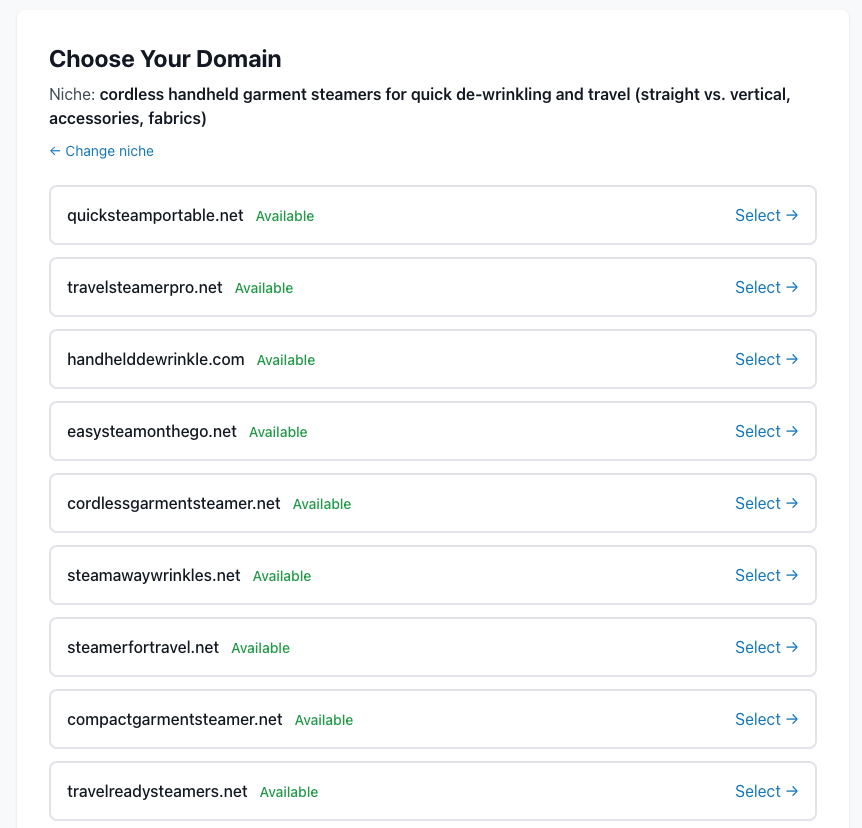
For a new domain, the deployment worker can purchase through Cloudflare Registrar. It first uses an AI search agent to suggest SEO-optimized domains.
Then it runs seven deployment phases in order through various APIs:
- domain registration;
- hosting and DNS setup;
- static-site setup;
- CDN and custom-domain configuration;
- Google Search Console setup and sitemap submission;
- GA4 provisioning;
- SlopAds/Blogment content connection.
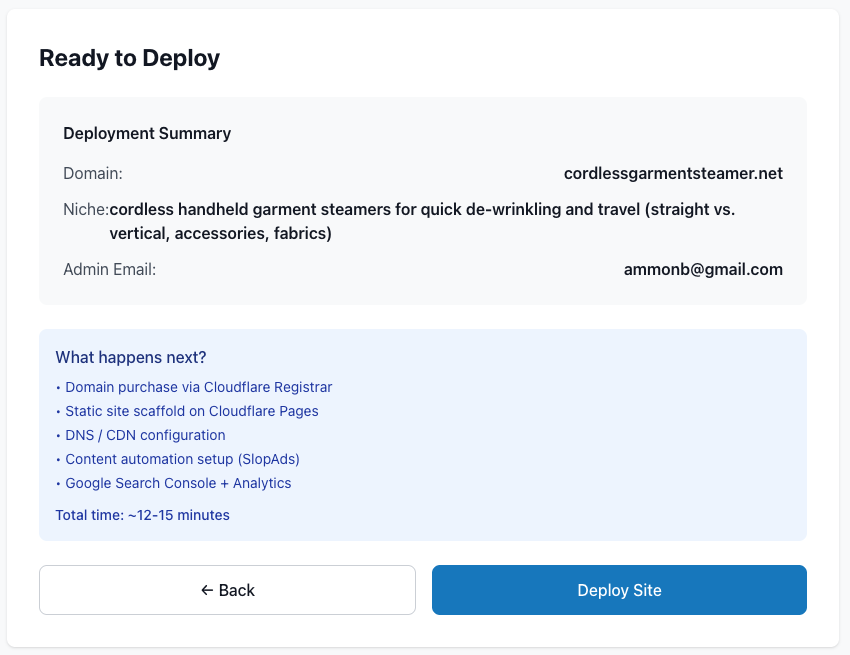
The old system used WordPress. The newer system emits static HTML from Python and Jinja templates and deploys it to Cloudflare Pages. There is less to patch, less to break, and the sites are blazing fast for SEO purposes.
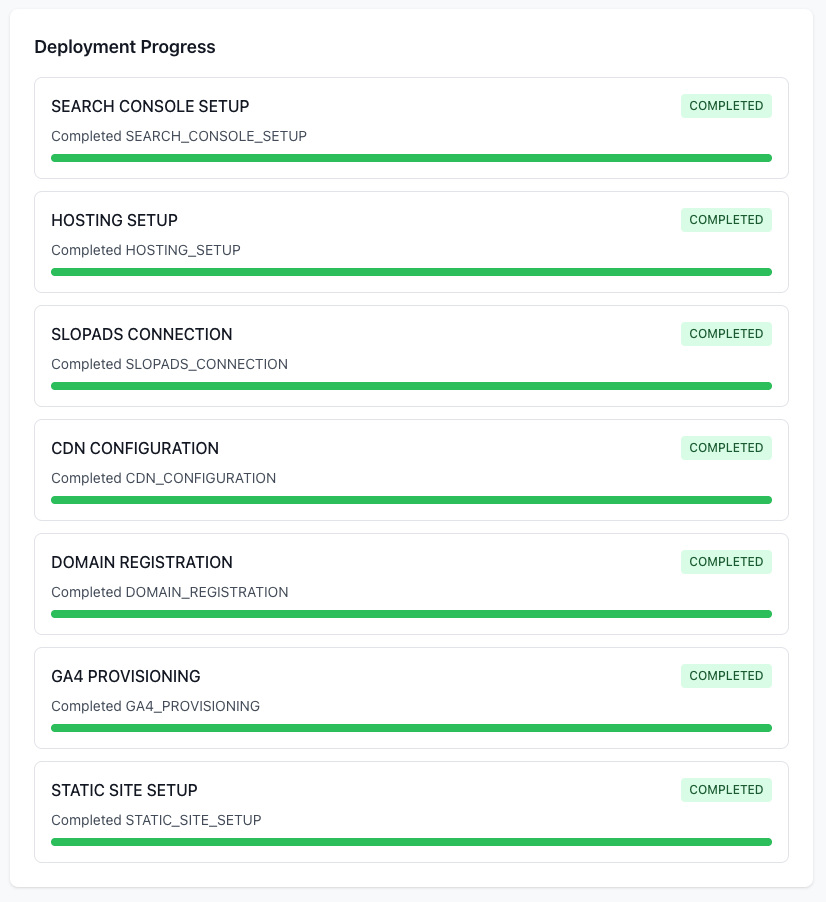
3. It makes a tiny brand
The setup process generates a site name, description, color palette, hero image, navigation, core pages, metadata, structured data, sitemap, robots file, and analytics configuration.
This generates a site that is coherent enough to exist without me choosing between 47 nearly identical shades of blue.
4. SlopAds/Blogment feeds the machine
SlopAds/Blogment is the content-generation layer, mostly so I can test the SaaS I built as an experiment. It handles keyword research, topic ideation, article generation, metadata, schema, images, and answer-oriented structures such as FAQs. I also built citation monitoring across the major LLMs to keep track of my LLM appearance.
Content Empire creates the campaign through the SlopAds API, receives new articles by API and webhook on a schedule, and converts each article into the portfolio’s canonical format. It was easy to interact with the SlopAds API because I control it, too. So I built what I needed.
5. It builds and deploys
The article is stored as structured JSON. The generator renders static HTML, category pages, product elements, Open Graph tags, schema, RSS, robots.txt, LLMs.txt, and an XML sitemap. The deployment process uploads the result to Cloudflare Pages and binds the custom domain.
The system also uses a Google Cloud service account to provision Google Search Console, Google Analytics, and add the sitemaps.
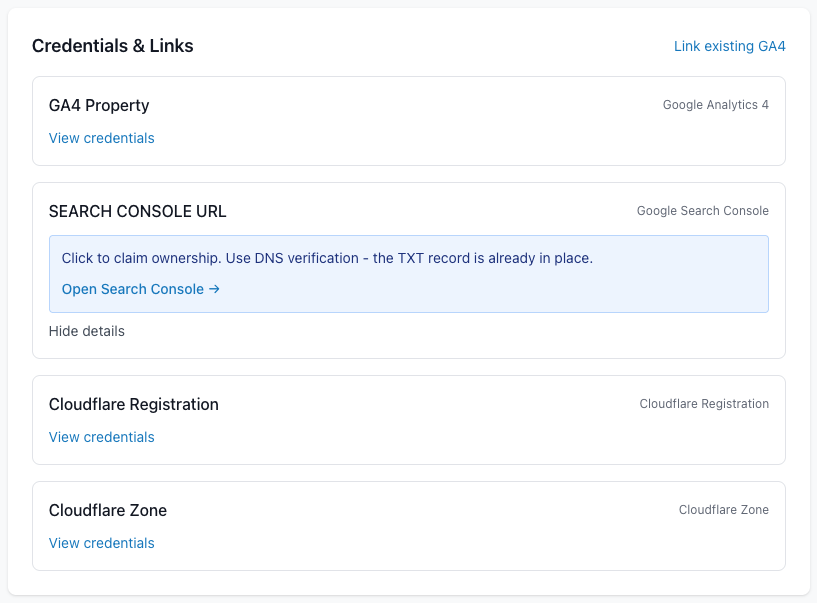
Changed URLs are then submitted through IndexNow, which lets participating search engines know that a URL was added, updated, or deleted. Not a guarantee of inclusion, but can’t hurt.
From finished content to live page, the original pipeline was designed to take seconds rather than an editorial sprint.
6. It watches everything
There are ten recurring job families in the scheduler. They cover:
- content synchronization;
- Google Search Console collection;
- GA4 collection;
- uptime and health checks;
- affiliate catalog synchronization and product verification;
- affiliate conversion synchronization;
- Bing data;
- Brave query presence;
- crawl validation.
Health checks run every four hours by default. Most of the portfolio collection and synchronization jobs run daily, as SlopAds auto-generates one article per day per site. I used cheap models on Groq to save money.
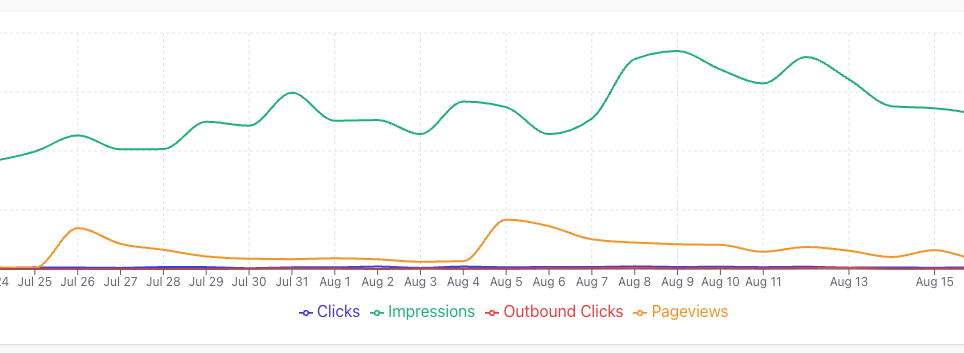
It also deploys a containerized admin panel to my VPS. The reporting dashboard aggregates GA and GSC data from the portfolio first and lets me drill into a site second. It shows search clicks, impressions, CTR, average position, sessions, pageviews, active users, and outbound clicks. Traffic can be grouped by source and medium, including referrals from answer engines when they actually send one.
Google Analytics can collect outbound-click events through enhanced measurement. Content Empire persists the source page, the exact destination, the link domain, and the click count so I can evaluate which sites and content are working.
Google Search console provides off-site metrics so I can track trends.
7. It decides whether to keep going
The latest layer is a portfolio autonomy gate that checks site health and reviews performance to identify clusters of performant search queries and find opportunities for further content ideas and internal linking.
If the system detects a lot of intent for a given topic, it will create category pages and cross-link similar articles. It will also generate new article ideas based on GSC query reports and push those topics to SlopAds for content generation.
It finds new niches and trends
Finally, I hacked together a system that scans TikTok, Google, Ebay, Amazon, and a few other sources every week to try to identify trends. It suggests new niches that I can jump onto quickly and pump out content.
The Results – Real Money but a Net Loss (so far)
Yes, my affiliate relationships have yielded money. However, they have not (yet) yielded the $600/year in domain purchases plus the ~$30 in LLM costs each month. However, I have only been doing this for a month or so, so yeah… That’s progress.
The affiliate program dashboards are aggregated into my dashboard as best I can, but they do not provide quite enough data, so the system sometimes has to guess.
This is why the reporting layer follows the full chain:
search impression → visit → landing page → outbound click → merchant → conversion → payout
The closer I can get to that chain, the less likely I am to optimize for a vanity metric while quietly losing (more) money.
Is this SEO, AEO, GEO, or just slop?
Mostly slop, but with learnings.
Traditional technical SEO still matters: crawlability, intent match, internal structure, titles, descriptions, links, performance, and evidence that a page is useful.
“AEO” is useful shorthand for making a page easy for an answer system to understand and cite. But there is no magic aeo_score = 97 field that causes ChatGPT to mail me a trophy. I treat it as a measurable bundle:
- direct answers near the top of the page;
- clear headings and extractable facts;
- structured data where it truthfully describes the page;
- stable entities, authorship, and provenance;
- original comparisons, calculations, or observations;
- referral traffic and citations when they can actually be observed;
- markdown versions of documents where it makes sense.
Google’s current AI search optimization guidance is almost aggressively unsexy: make non-commodity, useful content and do not create a separate page for every imagined query variation. That is inconvenient advice for anyone hoping to replace judgment with volume.
The opportunity engine is designed around that constraint. It uses real query-and-page data to find content refreshes, weak click-through rates, cannibalization, decay, and narrowly justified content gaps. It caps the number of weekly actions. It can now auto-generate link-bait calculators for each niche.
So, did it work?
Kind of. I am getting traffic from Google, Bing, ChatGPT, Perplexity, Claude, DuckDuckGo, and a bunch of smaller sources. I am getting a solid chunk of outbound clicks and a 4.5% conversion rate across the affiliate programs I am running.
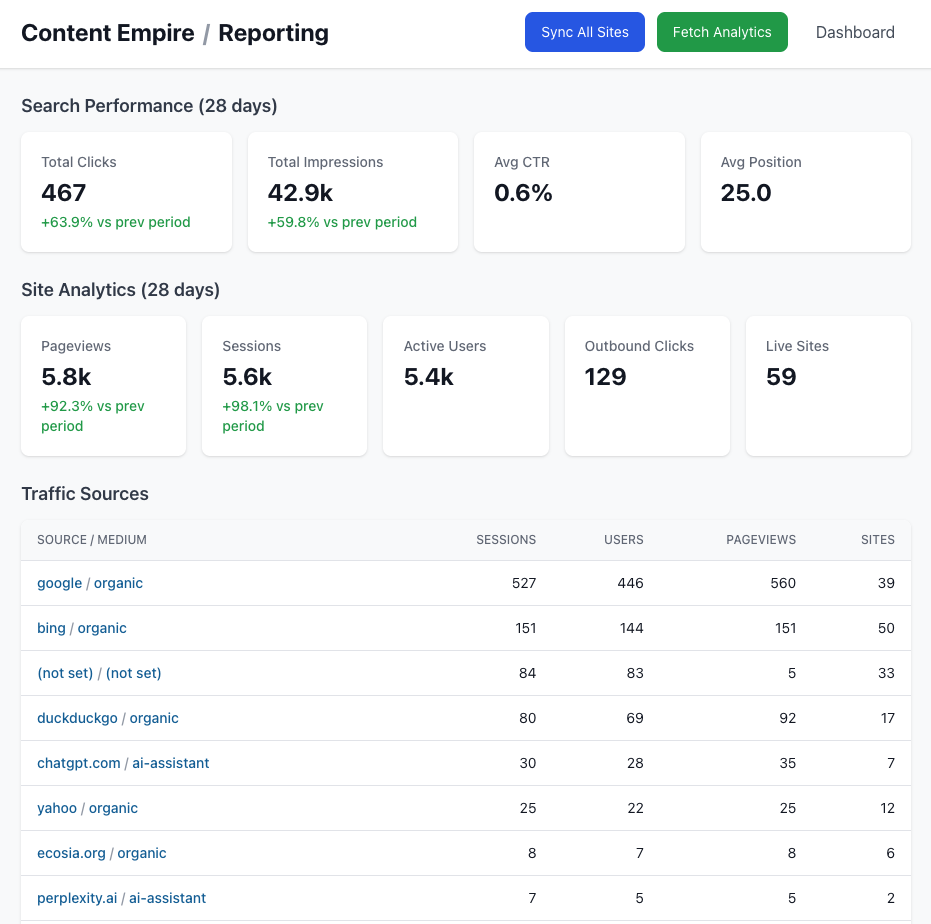
My current conclusion is that yes, a smartly-designed system can optimize itself into a content engine, but for how long? At least one of my sites already saw its search impressions go from 2K to 10, a clear penalty for low-value content. That’s just a prompt tuning challenge if you ask me.
Anyone can do this, too. It just requires knowing what to tell the LLM to do, knowing how to build the system, knowing SEO and AEO basics, and having the right tools to deploy and optimize. Then the ongoing work is really just refining a loop that can notice what is indexed, what is clicked, what sends a shopper, what breaks, what should be refreshed, and when the machine should stop.
That is the real Content Empire: not a robot writer, but a feedback system with publishing attached.
I would like to formally apologize to the internet
Am I contributing to the dead internet?
Yes.
Would it happen with or without me?
Yes.
If this portfolio grows organic visibility and revenue without producing obvious garbage, then the experiment says something uncomfortable about the economics of publishing. If it flatlines, the internet’s immune system works. If it spikes and later gets vaporized, I will have built an unusually elaborate demonstration of platform risk.
All three outcomes are worth documenting.
This post is itself part of the experiment. It has a direct answer, descriptive headings, first-party numbers, screenshots, a clear author, an original system, and enough phrases like “AI content automation” to make an SEO tool emit a reassuring green circle.
It also contains jokes, doubt, self-awareness, and a sentence about a raccoon (this one).
So perhaps the test is not humans versus AI.
Perhaps it is commodity output versus something worth citing.
Is this evil? I don’t know exactly where that line is. Is it brilliant? I think so but it is far from original. Sloppers and content factories have existed since ever since (Reddit being the biggest target).
Frequently asked angry questions
Is AI-generated content allowed in Google Search?
AI assistance is not automatically disallowed. Google’s published guidance focuses on whether content helps users and whether automation is being used primarily to manipulate rankings. Large volumes of low-value pages can violate its scaled content abuse policy.
Is Content Empire fully autonomous?
The normal publishing and measurement pipeline is designed to run on schedules and events without routine intervention. It still has external dependencies, operational failures, policy boundaries, and manual controls. Search Console manual actions and reconsideration remain human work. “Autonomous” means the normal loop can run alone, not that responsibility has been outsourced to cron.
Does AEO guarantee citations in ChatGPT or AI Overviews?
No. Clear answers, structured pages, original evidence, and strong technical foundations can make content easier to understand and reference. No honest operator can guarantee a citation from an answer engine.
Are the sites profitable?
Some revenue exists, as shown above. Portfolio profit requires subtracting domains, content generation, infrastructure, tools, taxes, and my time. Far from it at the moment, but there is a path.
Would I recommend doing this?
Only if the measurement and safety system interests you at least as much as the publishing button. The button is the easy part.
Will you show us the sites and provide links?
No. I do not want these sites to get banned and nuked from the planet until I have reached a conclusion about whether the internet as we know it is doomed.